Showing posts with label swordfighting. Show all posts

Monday, September 13, 2010

Sword Fighting throught the Ages - Part 3

Avast, me hearties! It’s finally time for those of you who write pirate stories to take the fore (deck). Today I’m blogging on Nic Harrison’s demonstration on sword fighting with a buckler. In other words, swashbuckling.

We’re up to the 16th century now.

1305 MS with Knight carrying a buckler on his hip


A buckle is a small shield, maybe about twice the diameter of man’s fist. It was normally carried strapped to your hip with your scabbard. It was used to deflect blows – the swash. The buckle part of the term comes from the response to a swash – you “buckle”. So the rhythm of a fight went swash, buckle, swash, buckle. The style of fighting goes back to the 13th century and continue right until the 18th.

Fighting with bucklers -- MS dates 1325


Swashbuckling descended from longsword technique. The sword was still a cutting weapon. But it was lighter, even though fighters were still using the sword itself to block opponents blows. The movement of the fight was still circular. As Nic put it, you followed the movement (the arc) of the sword. On the other hand, the pace of the fight had picked up. Blows fell a lot faster (which is probably why we enjoy watching those swashbuckler films so much.)

16th century swashbucklers -- with codpieces


Oh, about now I ought to mention cod pieces. They were not there to enhance a man’s sex appeal. Nic pointed out that all through the ages, men wore some sort of padding to protect their private parts. (Now you know what was REALLY under that kilt.) In a real fight, it was no holds barred. A blow to those parts, by sword or otherwise, could immobilize you and put your totally at the mercy of your opponent.


Viking Sword 9th century
At about this point in his sword fighting techniques demonstration for the Romance Wrtiers of New Zealand, Nic had his fighters through the ages come forward with their swords and let us compare them. The trend was obvious. Swords were getting longer and thinner. They were changing from cutting weapons to piercing ones. (Well, not entirely, but more on this in a bit.)
Norman Sword 11th century

Longsword 15th century


Part of this had to do with the fact that in the late 13th century, treatises began to appear on the art of sword fighting. By the 16th century, there were schools of sword fighting with masters running them. P lus income was affecting the type of sword a person used.


All right, previously, even back in the so called “Dark Ages” income influenced the weapon you chose. Everyone had a knife, but you had to have money to have a sword. They were expensive (probably the reason why they got passed from father to son and why they were part of ceremonial burials like Sutton Hoo.) The style of sword changed little through the early part of the medieval period, but by the 15th century the speed of change accelerated. Styles of swords had changed so quickly that your father’s sword no longer was suitable for you.

About 1670, the first treatise on civilian sword fighting appeared. Fencing became “the noble art of self-defense”. (The word “fence” comes from “defense”.)

And the rapier appeared – the “Queen of Swords”. The rapier was long and elegant. It gave a skilled fighter the ability to place his thrust exactly where he wanted. But – and here’s the big “but” – learning to fight this way took time. It takes three years to train a person to “fence”.

Swashbuckling, on the other hand, can be learned in three days.

We now have two classes of sword fighters – the common soldier and the gentleman.


Sword from Rennaissance period with finger ring(s)

With the rapier, the style of fighting changed. One of the changes had to do with putting your finger over the “guard” of the hilt. This allowed you to have better control of the point of the sword, so you could direct your thrust. But you needed some sort of protection, or your finger would be cut off. The most basic was the finger loop. As time passed, wire finger guards become more and more elaborate.

Rapier (16th century) with wire hilt


Another change was the direction of the footwork. Up to this point in time, the action of a fight had been circular. Now it was back and forth – following the forward, piercing thrust of the blade.

How a fight looked was different, too. The fight starts with the two opponents’ blades circling each other – looking for a weakness. The movement is subtle, of the wrist, rather than the whole arm, in contrast to earlier fighting with the medieval cutting-type sword, where the posing at the beginning involved moving your whole arm into different positions as you probed your opponent’s defenses.

When the two opponents finally engage it is in close. The two blades press against each other, as each fighter seeks to “command” his enemy’s weapon and trust it aside. Since the stronger part of any blade is near its hilt, you want to get the lower part of your blade engaged with the enemy’s blade for maximum strength. That means your whole body needs to be closer to his. While skill is important, at this stage of the encounter, strength counts, as well. The stronger arm is more likely to take command.


This part, the pressing, can go on for several seconds, until one or the other weakens or figures out a way to break the engagement (often with a thrust). The press is usually broken with a swift movement or two (and possibly a defense or counter-thrust), a hit and a withdrawal.


The swordsman using a rapier might enhance his defense with a second weapon. From 1580 to about 1620 rapier and dagger fighting was common. (When you went out, you inevitably strapped on your sword. It was part of a gentleman’s dress. A personal knife had been a part of everyone’s dress even in the early medieval period.) Another variation was using a short sword alongside the rapier.

Swashbuckling, by the way, continued in popularity in the military right up to the eighteenth century. By the 1800’s, though, the saber had become a common military weapon in Europe. The weapon actually came to western Europe through contact with the Hungarian Hussars, and probably goes back to the curved blades of the Turks. It is the only sword that can be used for both slashing and thrusting, though according to Nic, it’s predominantly a cutting weapon.

The saber was adopted for use by the cavalry, but early in its introduction, it was scorned by gentlemen, who still preferred the rapier or foil It wasn’t until the mid to late 19th century, when firearms had long replaced swords, that the saber became popular among gentlemen.

Nic ended his demonstration showing us the corrosion on the blade of the Crimean War saber that began my discussion of sword fighting techniques through the ages.

Monday, September 6, 2010

Sword Fighting Techniques Through the Ages -- Part 2

Last week I blogged on the demo on sword fighting I saw at the RWNZ conference. There was a heap of info, so I focused on what I learned about watching fighters using techniques from the Saxon and Viking periods (700-1100 AD.) Today’s topic is the next hunk of sword fighting history – the age of plate armor.


Plate armor appeared in the late 13th century. Nic Harrison, who’s one of NZ’s guru’s on authentic sword fighting (among other things he was the technical advisor for Lord of the Rings), said that plate armor was developed as a response to guns. I’ve heard elsewhere it was developed to protect knights from crossbows.  Nic showed us the tiny dent in a breastplate and explained it was the armorer's "proof of quality".  To test the strength of a piece of armor, the armorer would set it up and fire a bullet at it.  If the bullet went through, the armor got melted down and the metal reused.

I’m wondering, though, considering the power of the swords at the time, whether the move to plate armor might just be a better way to protect yourself from your opponent’s sword. Remember I said in my last blog that the blade of a sword of that period was designed to cut. It couldn’t do that through chain mail, but the power of the blow could crush and create internal injuries. Well, as Nic showed us, a powerful blow to plate armor generally just bounces off. There’s no bruising, as the plate spreads the force of the blow. At this point, knights stopped using shields, as the plate was the shield.


There area a few vulnerable places, though. One of them is the plate of armor designed to protect the knee. A sideways whack to that could create a dent that would immobilize the knee mechanism, so your opponent’s knee wouldn’t bend. There were also various “cracks” in the armor – places where one plate joined another. These remained vulnerable.


King Ludwig III wearing prominent poleyns -- knee armor.  A
blow to the side of the knee would lock the knee.
With two knights plated up like that, the encounter could last longer. But plate armor is a lot heavier than chain mail, so its weight would have tired you out.


To damage a person, you had to get in close and “command his sword”. You could do this by hooking it with your sword, your arm or your elbow. The idea was to immobilize it while you got in with your sword.


Using a sword to block a blow.

Blows got more sophisticated, too. One of the things that surprised me was how a knight would actually place his hands on his own blade to direct it. For example, one of the vulnerable spots is at the base of the neck, at the top of the chest plate. A knight might get in close to his opponent, hold his sword by one or two hands on the blade, (rather than both hands on the hilt), and use the lower hand to direct the tip of his blade into the crack between the top of the chest plate and his opponents neck. The upper hand would add strength to the blow, driving the sword down into the enemy’s lungs.


Another effective blow was what the Germans called the “murder stroke”. In this the knight held the sword by the blade. The left hand held the tip, the right was positioned half way up the blade. The hilt was in the air, with no hands on it at all. This effectively turned the half of the blade near the hilt into a club, and that’s exactly how it was used. The fighter would push the hilt forward in an arc towards his opponent’s head and bring it down through the middle of his skull or use it to hook him.

The knight on the right is moving in for a murder stroke.


Here his opponent uses the middle of his longsword to block the blow.


Italians were known for a type of stroke that used the pommel (end of the hilt) of the sword. The knight held his sword with both hands – one on the hilt, the other towards the tip. As his opponent slashed at him, his blocked his opponent’s blow by catching it with the middle of his sword. He then heaved his opponent’s sword aside and at the same time stepped to the left, “inside” his opponent’s reach. As he stepped to the left, he brought the pommel of his sword up into the fragile area under the opponent’s chin.


A smaller opponent would try to go for his opponent’s legs, especially the knee. Tall fighters learned to “defend low”.


I’ve been talking a lot about fighters holding their blades in their hands. Yes, they still didn’t wear gloves. And, yes, the things could cut your fingers off. Nic said the trick was how you held your sword. You never gripped it hard. Instead, according to the treatises on sword fighting from that period, you “hold your sword as if it were a bird.” Blows are “thrown”, not chopped.


Also, when you held your sword, you never wrapped your hand around it the way you would an ice cream cone. If you did, a yank from your opponent would cut your fingers off. Instead, you held it with your fingers curled over one edge of the blade, and your thumb stretched along the side of the other edge. With this kind of grip, an opponent cannot pull the sword from you hand.


When it came to the actual encounter, there was still a lot of posturing and moving around to get into position. Eighty percent of the fight is footwork. The two knights were trying to get each other to expose a vulnerable spot. Once one of those was exposed, they moved fast, attempting to take command of the enemy’s weapon, thrust it out of the way and thrust their own blade into a “keyhole” in the opponent’s armor.


By the fifteen century the long sword appeared. The long sword was the first weapon that could both defend and attack. The concept of “garde” was everything. It meant the potential to attack and defend, and basically was built around footwork and balance. You wanted to keep your weight centered. A lot of the blows were aimed at the face.


Thanks to the laws of physics, long swords had a lot of power behind them. So you didn’t try to block a blow from a long sword. But the power came from the arc of the blow and the distance the sword covered through air, which would build its force. Not it’s weight.


People talk about long swords being heavy. Except for ceremonial swords that were never used in battle, they were not. According to Nic, a good weight for a long sword was under 3.5 pounds (about a kilo and a half.) To use the long sword, you had to be fairly acrobatic and needed to be fit.


So what did you watch when you were in a fight and wanted to anticipate your opponent’s move? Nic said, never look at the sword. A good place to look is your opponent’s eyes, as they often give away where their next blow will be aimed. Feet and hands can also signal what an opponent is going to do next.


Next week: Swashbucklers, rapiers and maybe the saber. (Depending on how chatty I get.)

Monday, August 30, 2010

Bonus Post -- Sword Fighting References

A couple of the sword fighters from the RWNZ demonstration sat next to me at the lunch that followed their demo, and I picked their brains a bit.  Here are some internet sites they said had good, authentic information on sword fighting.

ARMA Association for Rennaissance Martial Arts.  Covers both the Middle Ages and the Rennaissance.  Focuses on serious study of the fighting techniques of that period.  http://www.thearma.org/  I've checked out this and it's got a wealth of information, including demo videos of fighting from various time periods.

Stoccata School of Defense.  http://www.stoccata.org/ Focuses on the Renaissance and beyond, with a small amount on the late Middle Ages.

Sword Forum International.  http://swordforum.com/  Focuses mostly in the weapons themselves.

SWORD FIGHTING TECHNIQUES THROUGH THE AGES – Part 1

The last morning of the RWNZ conference, sword expert Nic Harrison, assisted by eight or so sword fighters from three New Zealand historic sword fighting clubs, demonstrated a thousand years of sword fighting history to an enthusiastic audience of historical novelists.

Nic teaches historic sword fighting techniques. He’s been the technical consultant for a number of movies. The swords these fighters used were real weapons – not the blunted wooden swords used by the SCA. Most were replicas of ancient swords, but a couple were actual weapons from their time period, all beautifully maintained. Well, as well as possible. Nic show us black marks on one blade and commented that there’s only one thing that can corrode a sword like that. You guessed it. Nic commented there’s an irony in the fact that the only thing that can damage a sword is the one thing it’s designed to seek.

The first group to fight represented the Viking period, from about 800 to 1100 AD (later in the North.) Saxons, he said, would have used similar weapons and techniques. Most of our information on how Vikings fought comes from the Norse and Icelandic sagas.

Fighters of that period were well armed. They usually carried a round shield, a two-edged sword, a saex (a foot-long knife with a long triangular blade —the word “Saxon” comes from it), and often a fighting axe. They would wear a helmet and either armor constructed of leather or, if they could afford it, chain mail running to their knees. Altogether, their equipment could weigh has much as 35 kilos, about 80 pounds.

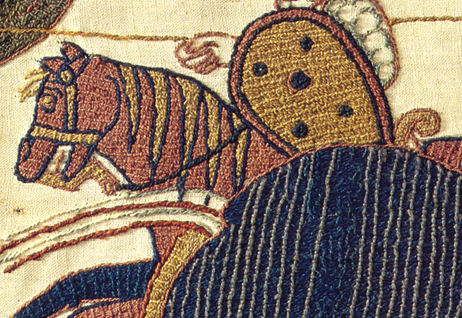
There’s no evidence that swordsmen of that period wore gloves, by the way. Even the fighters in the Bayeaux Tapestry, which depicts William the Conqueror’s 1066 invasion of English, had no gloves.


This picture from the Bayeaux Tapastry, by the way,
alos shows the knight carrying a heater as his shield.

The style of helmet changed through the period.


What our fighters were wearing wasn't much different from the famous
helmet from the Sutton Hoo burial pictured above.

Those from about 700 AD, which were what our demonstrators were wearing, were rounded on top and straight at the sides. They came half way down the face in the front, with eye-shaped holes cut for the eyes. Cheeks were exposed but a metal plate or nasal covered the nose. Often extra metal was added over the eyes to create an eyebrow effect. Nic commented that the intention of the helmet designer would have been to provoke fear in those looking at the wearer.

In fact, as they started to fight, fear was a good deal of the swordsmen’s strategy. There was a lot of posturing, posing and making of noise. Nic said that often the winner of a battle was determined by who stepped back first.

The shield was not only an important part of the fighter’s defense. It was part of the offense, as well. It could be used to push an opponent or to thrust his weapon aside.

Ideally, the shield should cover the fighter from his nipple to his knees, but the bigger a shield gets, the more it is vulnerable to being pulled by the wind. Shields were made of lightweight linden wood or a laminate of linden and oak, which combined lightness with strength. Some had steel bands on the face. They had straps on the back that the fighter slid his arm through. Most shields from that period were round, but heaters were also used.


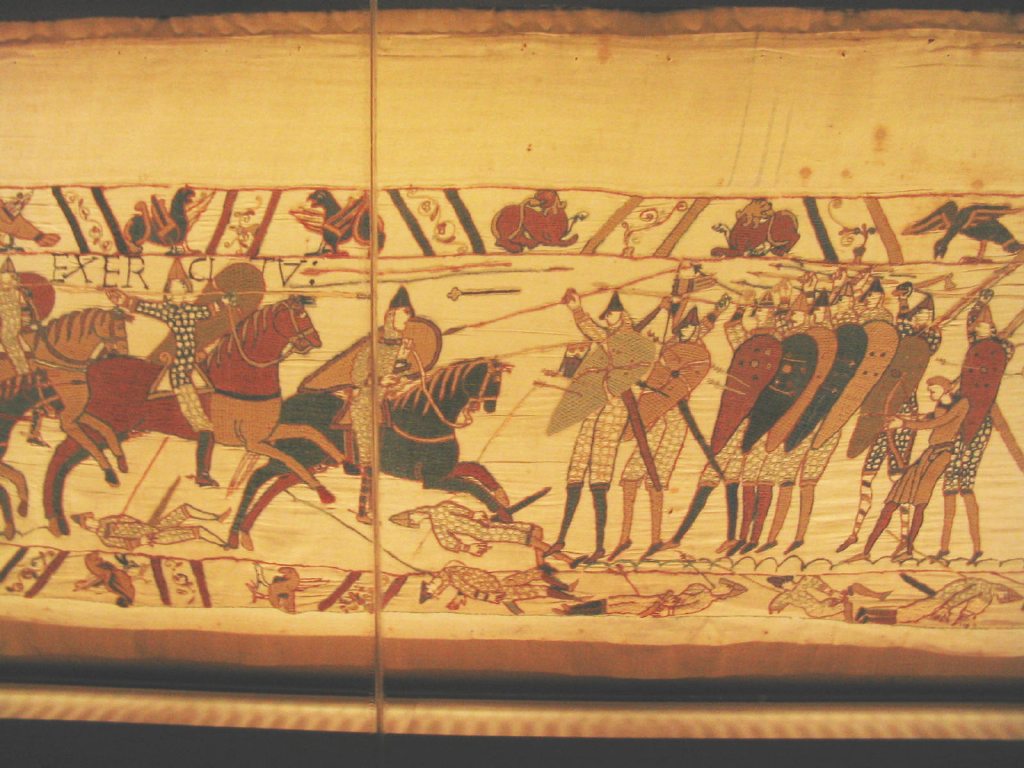
Anyone who’s read Bernard Cornwell’s King Alfred series knows of the formidability of a shield wall. Nic had the fighters demonstrate a shield wall for us and it was easy to see why opposing one would have been such a challenge. As the fighters stood shoulder to shoulder, their overlapping shields were locked to each other by tucking the shield’s right edge between the next soldier’s shield and his left arm. This created a virtually impenetrable wall across the army’s front. Further, two or more fighters so locked together could maneuver as a unit, providing a strong, wide front that would protect the weaker fighter.

Saxon defenders making a shield wall, from the Bayeaux Tapestry.
The shield wall is on the right.

Shield walls are not entirely impenetrable. Though an attacker couldn’t get through the shields themselves, he could go over the top, with a blow to the eyes or, more commonly, underneath, with a blow to the legs. Nic commented that battlefield burials are full of men with missing legs.

Here’s where a further Saxon/Viking weapon came in handy: the long axe. This is nothing more than an axe mounted on a handle as tall as a man. It gave its carrier the advantage of distance. It could be used to snake a shield away from a swordsman, making him vulnerable to the axe blow that followed.

Generally, though, Saxon/Viking combat was very close range. And individual encounters, contrary to what we read about in novels, didn’t last long. The demo fights we saw moved fast. One or two blows, that was it.

Nic said the average encounter – if one of the fighters didn’t back off immediately – usually lasted no more than 20 seconds, unless the combatants were evenly matched and extremely good. (Think of a battle as a series of encounters.) So when the sagas talk about a fight such as a holmgang – a ritualized fight settling a dispute between two men -- lasting for hours, they are playing up the skill of the two men.


How did a person get killed? Well, weapons from that period were designed to cut, rather than pierce. But unless, you succumbed to a blow in the face (King Harold Godwinson died at Hastings from an arrow in the eye) or losing a leg, you were not likely to die from a cut. Chain mail was good defense against the sharp edge of a sword. The power behind the blow, however, would crush the mail into you, cracking bones and creating internal injuries. That’s a lot harder for primitive medicine to treat than an open wound.

Next blog post: sword fighting in the age of plate armor.

Monday, August 9, 2010

Left-Handed Sword Fighting

Medraut, the hero in my Arthurian trilogy, is left-handed. I’ve often heard that left-handed fighters have the advantage (hence the term “sinister”, which is Latin for “left”). I decided to investigate how Medraut could use this to his benefit.

First stop, Stephan’s Florilegium (http://www.florilegium.org/). For those of you who aren’t familiar with this website, it’s a compendium of various on-line discussions between members of the Society of Creative Anachronism. Some of the material is extremely well-researched, though you have to be careful to ensure that the information you’re accessing is appropriate to your historical period, as the SCA covers everything from late Roman times to the Renaissance. There are also a lot of articles describing how to recreate historical technologies with modern materials, so you do have to keep on your toes. Probably the largest benefit to the articles, though, is the sheer volume of material on the practical details of how something feels or works. It’s articles like this, I find, that help me get into the heads of the people living with and using those technologies.

Click under “Combat” and you’ll find archived several articles on left-hand fighting (LH-fighting-msg).

OK, this is what I learned. There is something different when you’re right-handed facing a left-hand opponent. Blows fall differently. If you’re not used to fighting a lefty, it indeed does give the lefty an advantage. But only if the righty is inexperienced fighting a lefty. An experienced rightly like Lancelot, for example, could knock the sword out of Medraut’s left hand every time.

Unfortunately, SF didn’t give me the details of technique I wanted. And, darn, I know I’ve seen some good stuff somewhere! On to Google and “Left Handed Sword Fighting”. Hah! Just found “Heinrich’s Guide to Sinister Sword Fighting” http://www.duchyleuwenberg.com/sinister_swords.htm. Another member of SCA.

Now we’re into the nitty-gritty.

First, protecting yourself. Heinrich says, “As a left handed fighter, you will also get pounded along the left side of your body much more than a righty would his right. This is because you are mirrored to your opponent. Your sword side is directly across from his sword side. Your shoulders are going to be hit and well as your legs and rear end. Wear enough armor to cover these areas without sacrificing mobility.”

Shots: Believe it or not, the various thrusts a sword-fighter makes are called shots (at least in SCA.) And there are a lot of them. Heinrich comments, “You may want to avoid putting a thrusting tip on your sword especially at first as it will inhibit some of your key shots. By this I mean the quick snap shot to the face. This is a bread and butter shot that all lefties need to be able to throw quickly and accurately. You can end a fight before it even starts by throwing this quick flat to the face of your opponent as they come in on you or as you engage. This works well for righties as well so be aware.”

What makes fighting a lefty-so dangerous? There’s a lot of info about fighting techniques on a webpage by another SCA member, titled "Sword and Shield Fighting" (http://mysite.verizon.net/tsafa1/pell/index.htm). In addition to a lot of practical advice about weapons, armor, fitness and shots (and the link for a good video on U-tube where he demonstrates all this), he’s also got a whole section on fighting left-handed.

What makes fighting a lefty different from fighting a righty (if you’re right handed) is that the shots and defense all come from a different side? If you’ve had some practice sword-fighting, you automatically know where to move your sword and shield to counter the blows coming in. With a lefty, the same blows are coming from the opposite side. And your sword/shield may not be there in time to stop them. It’s easier for a lefty, for example, to hamstring a righty because their blows come in to the back of the righty’s leg.

The reason for the difference in direction of shots is how the two swordsmen’s equipment match up in a fight. In a right on right or left on left, your shield is opposite the opponent’s sword. So you’re in a position to deflect most of your opponent’s sword blows with your shield. With left-on-right, the configuration is shield to shield and sword to sword. In other words, as a righty, your sword arm is vulnerable to your opponent’s sword.

Somewhere I read – and I’m really frustrated because it was a long time ago I sourced this material and can’t find it now – that the smartest strategy for a lefty was to keep moving forward and around towards his/her left, which forces the righty to step back in order to protect his/her sword arm. This puts the opponent’s balance at risk, and balance is crucial for a good sword fight. It also forces the righty to shift his shield further over the front of his/her body, which limits his/her visibility.

Of course, a righty experienced at fighting a lefty can use exactly the same strategy on the lefty.

Finally, from My Armory dot com (http://www.myarmoury.com/talk/viewtopic.php?t=4541) a little bit on how a good righty could defend him/herself against a lefty: “IMHO as a right-handed fighter I would be inclined to move in very fast right sloping steps (i.e. counter-clockwise) around the left-hander's outside to 1) keep away from their shield, 2) close in and bind up their sword arm with my shield, 3) attack from behind with my short edge to their head, neck ,shoulder, back, torso, hip, back of thigh, or back of knee, or long edge to the calf, lower leg or ankle, maintaining pressure with the shield the whole time. Should they disengage I would continue circling right so that any strike they could manage would be back-handed and easily deflected with my shield while presenting me with a number of open long-edge targets along their outside. I think such maneuvering would negate most blade contact while employing the shield in exactly the way it is intended to be, as a dynamic defensive barrier. I think the trick is to maintain superior speed and not be thrown off by the idea of fighting a left-hander, just get in quick, tie them up, and cut them down. Again this is strictly IMHO.”

OK, Medraut, you have a lot to learn.

BTW, the realities of life have struck and I’m going to have to limit my blogging to once a week, if I’m going to do a good job of it. I’ll be posting my blogs on Mondays New Zealand time from now on (that’s Sundays for you in the Western hemisphere.)