Showing posts with label Anglo-Saxon England. Show all posts

Monday, December 27, 2010

Yule Logs

It being the Christmas season, I thought I’d do a little research on Yule logs. In The Black Crown, the yule log is being dragged into Camelot’s main hall just after Arthur is forced to pass judgment on Guenevere:


Medraut shivered as he and Arthur strode towards the king’s work room. There was a draft in the Great Hall. They had opened the doors to bring in the Yule log.

“I want you to take charge of the execution,” Arthur said as they paused to let pass a group of giggling pages carrying garlands of holly. Absently he mussed the hair of the smallest lad, who looked up at the High King with adoration in his eyes.

Arthur had never mussed his hair like that. For a second, jealousy overshadowed the task to which Medraut had been set. Then he realized what his father had just commanded. “Sire?”

Arthur’s eyes swept the hall, taking in the Christmas preparations, his brow raised in surprise. Shrugging, he hurried on past the dais where maids spread fresh, white linens across the board. “It’s to be in two days. I want the wood good and green. Plenty of smoke. Less painful that way.”
That got me thinking about the Yule log tradition. My Camelot is still set in an alternative 12th century, although, yes, as you know, I am playing with changing it to the 6th. I wondered how the Yule log would play out in each of those scenarios.


Most web sites claim that the Yule log is a very old tradition, going back to the pre-Roman Germanic peoples of northern Europe, or to the Celts. Other sources say it may have been Egyptian in origin, or part of the incorporation of the Persian sun-god Mithras into the Roman saturnalia. (Mithrasism spread into Britain with the Roman invasion in 54BC.)


On the other hand, other web sites say that this is all speculation, that the Yule log did not appear in Britain until the 17th century, when first mention of it was recorded by a British clergyman.


Well, the first mention of the Yule log was not the 1620s or 30’s. As early as 336 AD Pope Julius I, when he declared that Christmas should replace Saturnalia as a festival, stated that the burning of the log would symbolize the light of Christ. As the a fire, light the first night of the Saturnalia, was a Roman custom, it would, of course, have made its way into Roman Britian.

In addition, it appears that the Normans, pre-conquest, burned a log at Christmas, a custom they continued from their ancestors, the “Northmen” who invaded what is today Normandy.


Not matter what its source, the yule log as a tradition, appears to have been established in Britian by the 12th century. An English poem dated 1182 refers to it. The same custom appears in other parts of Europe. In 1184, a German parish priest recorded bringing in a tree to kindle the Christmas festival fire. By 1340 Queen’s College, Oxford, included a yule log in its festivities. The celebration included a song and readings.


So how did the log work?


Over that there seems to be quite a bit of debate. Some people say it would have had to be big enough to burn over the full twelve days of Christmas. Interestingly, I could find no historical reference to the twelve days of Christmas being celebrated in the Middle Ages, though certainly by Shakespeare’s time it was an established fact. In fact, in the Middle Ages, the last day of the period, the Epiphany appears to be more associated with religious practices than misrule – and twelve days of celebration do not seem to be a recorded fact. Gift-giving, by the way, happened on the Epiphany, not Christmas, which makes sense as that was the day the wise men were supposed to have arrived with gifts for the Christ child.


A log big enough to burn over 12 days would have had to be huge, indeed. And the big question is, in practical terms, would it have burned down the hall? Some references I’ve seen say that the big end was poked into the fireplace and it was slowly “fed” to the fire in time. Well, if the wood was dry or pitchy, what’s to stop the fire from creeping along the bark, out into the hall? Fireplaces with chimneys themselves (as opposed to an open hearth in the centre of the floor) did not appear until the 12th century. Another reference says the log was cut into sections and fed into the fire a section a day. This makes more sense.


So what if you had the old kind of hearth, where the fire is made in the centre of the hall and the smoke drifts up through hole(s) in the roof? If a big log got burning, it would create an uncomfortably hot room. In fact, the heat from a big fire like that would possible drive people from the hall. But if you tried to slow the burn by possibly using a green log or throwing water on the log, you would create so much smoke, you’d drive everyone from the hall.


If you live in a 6th or 7th century Saxon-style hall, you’ve still got the danger from fire. These halls were built from wood, with an A-shaped roof. There were one or more raised, earthen banks along the centre line where the fires burned. But these structures also contained a dug-out cellar below the main floor (this is where Sioneh and Medraut are imprisoned in The Deadly Peace) – and the flooring above was wood. Unless managed carefully, a Yule log rolling off the hearth could burn down the whole hall.


I think we can safely guess that the log would have had to fit in the hearth (whether the chimney type or the open fire). And that it would have had to be chosen carefully so that it provided a good blaze without burning down the place or creating so much smoke everyone was miserable. It would probably have been a hardwood, cut earlier in the year and seasoned so it would burn without producing too much smoke.


The perfect wood for this, by the way, is oak. Oak burns very slowly and without much smoke. In fact, a couple of oak doors saved my life many years ago when the oil furnace in the hundred-year-old house I was living in caught fire. There just happened to be a couple of old oak doors propped near the furnace and they contained the blaze. The oily smoke pouring from the cellar alarmed a passer-by, who got everyone out of the house.


Anyway, getting back to the Yule log, considering the careful planning it would have taken, its procurement was probably the job of one man – possibly the manor’s forester. He would have had the necessary skill and experience to judge the correct tree and when to cut it.


But I wonder how many halls burnt down at Christmas time?

Sunday, October 3, 2010

Maybe Camelot Wasn't off the Mark?

Don’t let it be forgot
That once there was a spot
For one brief, shining moment
That was known as Camelot!
 Lerner & Lowe


Before I started my reports on the RWNZ conference, I was blogging searching for the “historical” King Arthur and discovered that the Ango-Saxon invasions, on which Arthur’s existence is predicated, may never have happened. If Britain wasn’t under siege, so to speak, by invaders, what was happening?

Archaeologist Francis Pryor and the various academic specialists he interviewed in the BBC TV Series Britain AD and Pryor’s book by the same name, paint a picture that is bright, indeed.

According to Pryor, Britain during the 5th and 6th centuries, the period after the Roman withdrawal, was a centre of culture that spread through Europe and whose fame and influence stretched as far as Byzantium.

One of the clues lies in the “Class 1” inscribed stones. (Class 1 refers to the dating, approximately 5th through 7th centuries.)  The Class 1 stones found in Scotland and the north of England have gained a lot of attention as it's speculated they're evidence of Pictish culture.  But those found mainly in Wales but also in southern Britain, tell a different, equally interesting story. 

These are memorial stones, erected to commemorate the dead. Originally the Latin on these inscriptions was thought to be the ramblings of semi-literate individuals. Then scholars had the idea of reading them out loud and discovered that they were poetry that employed the rhyme and scansion of sophisticated Latin verse. Furthermore, some of these inscriptions could be read both forward to end and backward to front and reveal completely different meanings. According to scholars David Howlett and Charles Thomas, this is the work of people who are literate and well-educated. They are evidence of highly sophisticated centers of learning, not ignorant hidey-holes of a collapsing civilization.

By the fifth century, Britain was fully Christianized. Contrary to popular belief, paganism was long gone. But the church of Britain was the Celtic church, not the Roman church. It was a well-organized church based on a monastic model, as opposed to the ecclesiastical model with bishops and priests centered in Rome. Its practices were slightly different, and, as such, it was a threat to Rome, which gradually over the next two centuries gained the ascendency. More on this in another blog, because it’s another piece to the picture. What is significant to note now is that there are monastic centers of learning all over Britain. This is not a country fallen into a Dark Age. Not only that, but the Celtic church is spreading its influence all over Europe, not the other way around.


Tintagel.  The "bumps" in the hillside are post-Roman homes.

Another piece to the picture is the evidence of trade with centers of civilization as far away as Byzantium. I’ve already talked about the “forts” along the Saxon Shore actually being trade depots, rather than defensive structures. But the Saxon Shore ports were probably oriented towards trade with northern Europe. Tintagel Castle, long been associated with the King Arthur myth, appears to have been a main entry port for even more distant market. Archeologists have excavated “bumps” all over the peninsula that have turned out to be early Christian houses from the fifth and sixth centuries. The buildings are full of luxury goods from remote ports. Pryor lists “glassware from southern Spain, wine amphorae from Byzantium, oil jars and fine tableware from the North African coast”. Tintagel was a centre of wealth. But even more amazing, if you look at the map on p. 182 of Pryor’s book Britain AD, you discover that similar findings are distributed across Britain, mostly in the southwest, but as far away as substantial finds in Dumbarton and Whithorn in Scotland and Hull on the east coast.

This is a moneyed civilization. A site at the mouth of the Avon River shows trade going on in a grand scale with amphora of Byzantine wine being consumed, huge numbers of animals roast over open pits, and piles of broken but expansive Byzantine tableware. Shipwrecks from the period off the southern coast of England contain rich trade goods from the Mediterrranean. I’ve mentioned that the period after the Roman withdrawal seems to have been a period of reconstruction and renewal, with old Roman civitas and villas being enlarged and given face lifts. Historian Michael Jones has suggested that when the Britains no longer had to pay taxes to Rome, they started spending the money on themselves.

Dark Ages? Hardly. Instead, the “Arthurian period” of British history appears to be a golden age worthy of the Camelot legend itself!

Monday, August 30, 2010

Bonus Post -- Sword Fighting References

A couple of the sword fighters from the RWNZ demonstration sat next to me at the lunch that followed their demo, and I picked their brains a bit.  Here are some internet sites they said had good, authentic information on sword fighting.

ARMA Association for Rennaissance Martial Arts.  Covers both the Middle Ages and the Rennaissance.  Focuses on serious study of the fighting techniques of that period.  http://www.thearma.org/  I've checked out this and it's got a wealth of information, including demo videos of fighting from various time periods.

Stoccata School of Defense.  http://www.stoccata.org/ Focuses on the Renaissance and beyond, with a small amount on the late Middle Ages.

Sword Forum International.  http://swordforum.com/  Focuses mostly in the weapons themselves.

SWORD FIGHTING TECHNIQUES THROUGH THE AGES – Part 1

The last morning of the RWNZ conference, sword expert Nic Harrison, assisted by eight or so sword fighters from three New Zealand historic sword fighting clubs, demonstrated a thousand years of sword fighting history to an enthusiastic audience of historical novelists.

Nic teaches historic sword fighting techniques. He’s been the technical consultant for a number of movies. The swords these fighters used were real weapons – not the blunted wooden swords used by the SCA. Most were replicas of ancient swords, but a couple were actual weapons from their time period, all beautifully maintained. Well, as well as possible. Nic show us black marks on one blade and commented that there’s only one thing that can corrode a sword like that. You guessed it. Nic commented there’s an irony in the fact that the only thing that can damage a sword is the one thing it’s designed to seek.

The first group to fight represented the Viking period, from about 800 to 1100 AD (later in the North.) Saxons, he said, would have used similar weapons and techniques. Most of our information on how Vikings fought comes from the Norse and Icelandic sagas.

Fighters of that period were well armed. They usually carried a round shield, a two-edged sword, a saex (a foot-long knife with a long triangular blade —the word “Saxon” comes from it), and often a fighting axe. They would wear a helmet and either armor constructed of leather or, if they could afford it, chain mail running to their knees. Altogether, their equipment could weigh has much as 35 kilos, about 80 pounds.

There’s no evidence that swordsmen of that period wore gloves, by the way. Even the fighters in the Bayeaux Tapestry, which depicts William the Conqueror’s 1066 invasion of English, had no gloves.


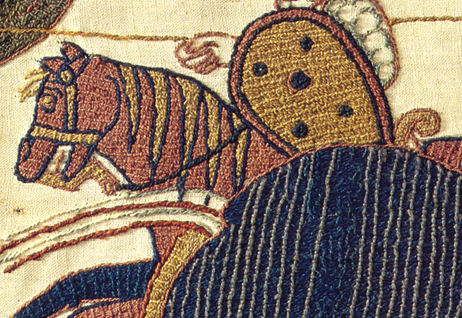
This picture from the Bayeaux Tapastry, by the way,
alos shows the knight carrying a heater as his shield.

The style of helmet changed through the period.


What our fighters were wearing wasn't much different from the famous
helmet from the Sutton Hoo burial pictured above.

Those from about 700 AD, which were what our demonstrators were wearing, were rounded on top and straight at the sides. They came half way down the face in the front, with eye-shaped holes cut for the eyes. Cheeks were exposed but a metal plate or nasal covered the nose. Often extra metal was added over the eyes to create an eyebrow effect. Nic commented that the intention of the helmet designer would have been to provoke fear in those looking at the wearer.

In fact, as they started to fight, fear was a good deal of the swordsmen’s strategy. There was a lot of posturing, posing and making of noise. Nic said that often the winner of a battle was determined by who stepped back first.

The shield was not only an important part of the fighter’s defense. It was part of the offense, as well. It could be used to push an opponent or to thrust his weapon aside.

Ideally, the shield should cover the fighter from his nipple to his knees, but the bigger a shield gets, the more it is vulnerable to being pulled by the wind. Shields were made of lightweight linden wood or a laminate of linden and oak, which combined lightness with strength. Some had steel bands on the face. They had straps on the back that the fighter slid his arm through. Most shields from that period were round, but heaters were also used.


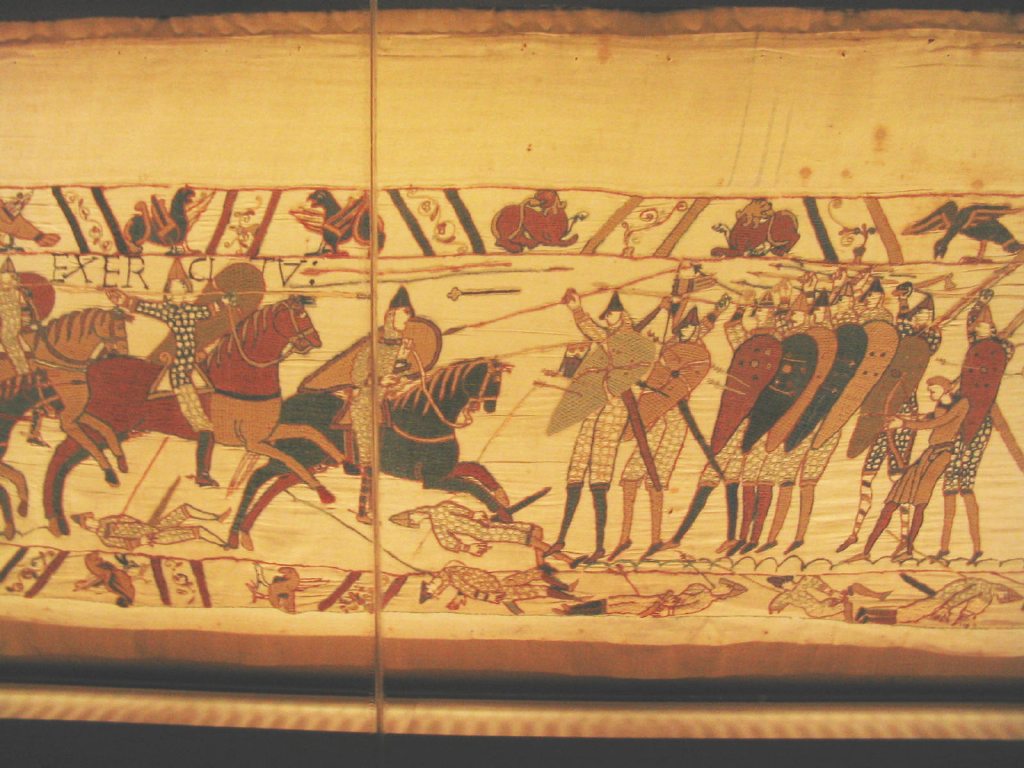
Anyone who’s read Bernard Cornwell’s King Alfred series knows of the formidability of a shield wall. Nic had the fighters demonstrate a shield wall for us and it was easy to see why opposing one would have been such a challenge. As the fighters stood shoulder to shoulder, their overlapping shields were locked to each other by tucking the shield’s right edge between the next soldier’s shield and his left arm. This created a virtually impenetrable wall across the army’s front. Further, two or more fighters so locked together could maneuver as a unit, providing a strong, wide front that would protect the weaker fighter.

Saxon defenders making a shield wall, from the Bayeaux Tapestry.
The shield wall is on the right.

Shield walls are not entirely impenetrable. Though an attacker couldn’t get through the shields themselves, he could go over the top, with a blow to the eyes or, more commonly, underneath, with a blow to the legs. Nic commented that battlefield burials are full of men with missing legs.

Here’s where a further Saxon/Viking weapon came in handy: the long axe. This is nothing more than an axe mounted on a handle as tall as a man. It gave its carrier the advantage of distance. It could be used to snake a shield away from a swordsman, making him vulnerable to the axe blow that followed.

Generally, though, Saxon/Viking combat was very close range. And individual encounters, contrary to what we read about in novels, didn’t last long. The demo fights we saw moved fast. One or two blows, that was it.

Nic said the average encounter – if one of the fighters didn’t back off immediately – usually lasted no more than 20 seconds, unless the combatants were evenly matched and extremely good. (Think of a battle as a series of encounters.) So when the sagas talk about a fight such as a holmgang – a ritualized fight settling a dispute between two men -- lasting for hours, they are playing up the skill of the two men.


How did a person get killed? Well, weapons from that period were designed to cut, rather than pierce. But unless, you succumbed to a blow in the face (King Harold Godwinson died at Hastings from an arrow in the eye) or losing a leg, you were not likely to die from a cut. Chain mail was good defense against the sharp edge of a sword. The power behind the blow, however, would crush the mail into you, cracking bones and creating internal injuries. That’s a lot harder for primitive medicine to treat than an open wound.

Next blog post: sword fighting in the age of plate armor.

Monday, August 16, 2010

The Saxon Non-Invasion – More Evidence

I’ve been blogging about the evidence against a Saxon invasion of Britain in the fifth and sixth centuries. I’ve mentioned that the type of vessels the Germanic peoples had during that time period were not likely to be able to carry over troops in the scale an invasion would require, and that the forts along the “Saxon Shore” – the southeastern coast of England – were more likely supply or trade depots than provision for defense.

There’s other evidence I’ve unearthed as well.

First, there’s the myth that when the Romans pulled out, everything fell to pieces. The population dropped. Farmers abandoned their lands and it went back to forest.

Well, Michael Jones in The End of Roman Britain notes that Britain did not turn into a wasteland. In fact, it supported a healthy population of 4 million or more. He also points out that, rather than returning to forest, the era shows evidence of more forest being cleared.

Jones’s assertion is supported by the pollen studies described in Episode 2 of the BBC TV series, Britain AD, hosted by Francis Pryor. You can view this episode on U-Tube. http://www.youtube.com/watch?v=LRC3KAqwT1Y&feature=related
It makes fascinating watching because it piles up the evidence against a large-scale invasion. Pryor’s book Britain AD, which I’ve quoted in this post and elsewhere in my blogs is an expansion of the ideas in the TV series.

Anyway, pollen studies are based on the premise that the pollen of plants growing in an area get deposited into the soil, where it remains for thousands of years. By taking a soil core, you can see what was growing in the area during a particular period of time. Core samples taken all over Britain show that the land did not revert to forest, as has been traditionally suggested. Instead, the same land continued to be farmed. There were no vast wildernesses.

Second, when there is an invasion, you expect archaeological evidence in the form of towns and villages destroyed, buildings burned, and religious shrines (especially) sacked and destroyed. With a few exceptions, there is almost no evidence of this throughout Britain for that time period. Instead there appears to be a period of building and expansion (this is the period in which Wroxeter grew from a small fort to a major center) throughout the land.

Francis Pryor, in his book Britain AD lists dig after archaeological dig in which continuity, not destruction, is evident, and in which “Celtic” and “Saxon” families appear to live side by side. He states, “Whenever archaeologists have taken a close look at the development of a particular piece of British landscape, it is difficult to find evidence for the scale of discontinuity one would expect had there been a mass migration from the Continent.” (Britain AD, p. 15)

Third, there is the issue of DNA testing. The BBC show provides some interesting evidence that might support an invasion. A researcher testing the males on the eastern side of the UK, found a preponderance of genes that are supposed to link to Anglo-Saxon traits. The problem is another team of DNA experts at the same university found totally conflicting results.

Today historians and archaelogists are split between two camps. Traditionalists still maintain that the theory of a large-scale Anglo-Saxon invasion explains the changes in culture and language which Britian experienced. But at least half the historians and archaelogists working at the coal face of research today maintain that these changes can easily be explained by forces and processes that don’t require an invasion.

And if there was no invasion, then there was no need for an Arthur to save Britain. Or was there?

Monday, August 2, 2010

The Saxon Shore -- Evidence of Prospertity?

The Saxon Shore forts are imposing stone fortresses along the southeast shore of England. Dominating the coastline where they are set, the forts are probably the most impressive examples of Roman architecture remaining in Britain today. In my last blog I talked about where their name came from -- the region in a 4th century Roman military document was referred to as “The Saxon Shore”. Popular wisdom has it that the forts were established to ward of Saxon invasions, but scholars today are questioning that theory.

Here are some alternatives that have been put forth. All consider the Germanic threat to have had minimal impact on the decision to build the forts. In other words, they don’t think there was much threat.

Donald A. White looks at the historical context of the dates of construction. Caurausius and Allectus had led the British in a successful rebellion against the Romans in 289-296. White proposes that the forts were actually constructed to prevent a Roman invasion to retake the island.

Also taking into account historical context, John Cotterill proposes that the forts were, in fact, constructed to supply the Roman army on the Continent with grain and products from Britain. Remember, they were built pre-410 AD when the Romans withdrew. Britain was one of the principal “granaries” of the Roman Empire.

The most recent work was done by Andrew Pearson, who examined each of the forts in detail and within their local context. He came up with some startling conclusions.

First, the forts were not built all at the same time, which argues against an integrated defense system. (Francis Pryor in his book Britain AD notes that the Roman military document in which the forts were mentioned was a listing of what was there, not a strategic plan.)

At the beginning of the third century Dover, an older Roman fort, went out of use, while Caister-on-Sea, Reculver and Brancaster were built. This leads us to wonder if there was a need for defensive structures, why was Dover retired? In fact, the deployment of these structures makes no sense militarily, if they were intended to protect the coast from Saxon raiders. They are all way up north, near the Wash, rather than down along Suffolk, Sussex, Essex, Kent and Hampshire, which were closer to the Continent and much more susceptible to Saxon attack.

The remaining forts were built during the last 40 years of the 3rd century. Portchester was abandoned for a period of ten years directly after its construction and at least half line were abandoned when the Romans withdrew, which theoretically would have been the time Britain was most vulnerable.

Francis Pryor provides an account of the archeological evidence for the purpose of the Saxon Shore forts. He notes how different these forts are from the Roman forts along Hadrian’s Wall.

Now, there is no question that Hadrian’s Wall and its chain of forts is a defensive structure. Furthermore, if you examine Birdowald, Housesteads, or Carlisle (my own pet as it’s my heroine’s home “castle”), you’ll discover a similar pattern. The fort is square or rectangular, with a gate centered in each of its four walls. The gates are set opposite each other and a road leads from one gate to its opposing gate. This creates a grid around which a large number of buildings are crammed in a very orderly, logical fashion. The pattern repeats throughout the Roman Empire.

Pearson noted evidence of an orderly military-style grid at Reculver, and that the other two early forts appear to have layouts intended for defense. The layout of the remaining Saxon Shore forts, however, are nothing like that. Portchester, especially, has been subject to intense excavation by archaeologist Barry Cunliffe, who is extremely respected for his meticulous field work. There is no evidence of the cramming with permanent structures set on a well-organized grid. In fact, there seems to be a paucity of structures within these forts. There are large empty areas. Strucures that existed were laid out in a haphazard fashion. Remains found in these structures, including infant burials, give evidence of civilian occupancy, instead. It’s been suggested that large areas of the forts were used to store goods.

Pearson and Pryor both feel that these fortresses, rather than serving as a defense network, may have served as collecting and distribution points for British trade.

Pryor in the vast collection of archeological evidence he references in Britain AD, asserts that rather than collapsing after the Roman withdrawal, Celtic Britain experienced an economic boom instead. His hypothesis is supported by Michael Jones, to whom I referred in an earlier blog, and a number of the scholarly articles collected in The Celtic World, the mammoth, academic tome edited by Miranda Greene.

No longer weighed down by the immense burden of taxes paid to Rome, Britains had more money to spend on themselves and their country. There was a building boom, with the revival and refurbishment of many settlements. And, there was a lot of trade abroad. (Pryor gives a vast amount of evidence in the last chapter of his book Britain AD.) This is where the Saxon Shore forts come in. Pearson has noted that they are almost all located at points like near the mouths of rivers or at road junctions that make them ideal of the collection and distributions of goods.

During Roman times, then, these ports may have been used as Cotterill proposed, to send British products to supply Rome. But upon Rome’s withdrawal, they may have remained as trade centers for Britain’s commerce with the Continent. Not all – remember some were abandoned. But that still leaves the other half.

No matter how you look at it, that leaves the Saxon Shore forts as evidence of a period of prosperity – not of a country hunkering down under prospective Saxon threat.

Friday, July 30, 2010

Saxon Shore Forts -- Proof of Invasion?

In my last blog I talked about what I’d learned about Saxon longboats from the fifth and sixth centuries. Rowed and not particularly seaworthy, they were incapable of making the rough crossing over the North Sea. As a result, invaders of Britain would have had to follow Europe’s coast and row across where the Channel narrowed. I also noted that each longboat could carry at maximum 50-60 men, and that the numbers of boats recorded don’t seem the equivalent to invading armies. Only 700-900 men spread out over fifty years!

My memory drifts to Jack Whyte’s wonderful Arthurian novels, one of which is titled The Saxon Shore. If there weren’t invaders, what about the forts along the Saxon Shore? Popular wisdom has that these forts were built by the Romans during the 3rd century to ward off Saxon invaders.

The nine Saxon Shore forts curve around southestern Britain, running from Brancaster in Norfolk to Portchester in Hampshire. The other seven are Burgh,Norfolk; Bradwell-on-Sea, Essex; Reculver, Richborough, Dover and Lympne, all in Kent; and Pevensey, Sussex.

The name given to the forts collectively refers to their supposed supreme commander, the Count of the Saxon Shore. The first (and only) reference we have of him comes from a late 4th century Roman military document known as the Notitia Dignitatum. This is one of the few surviving documents that show how Roman forces were actually disposed. It lists a Comes Litoris Saxonici per Britanniam – a Count of the Saxon Shore in Britain – as well as the officers and troops serving in each of the forts.

This certainly sounds like a defensive line, until you look at the other entries in Notitia Dignitatum. There are two similar strings of forts running around Brittany and Normandy and along the Belgian Coast. The officers in charge there are the Dux tractus Amoricani et Nervicani and the Dux Belgicae Secundae – the Duke/Leader of Amorica and Nervica and the Duke/Leader of Second(ary) Belgica. (Belgium)

Plus there are similar forts in Yorkshire and along the Devonshire and Cornwell shores.

If the purpose of the forts on the Saxon Shore were to keep out Saxon invaders, what are the forts doing on the other side of the Channel? We don’t hear about Saxon invaders there. While Yorkshire is a possible landing place, the approach Yorkshire is through the North Sea. As we’ve seen, Saxon ships would not survive a crossing there. Devonshire and Cornwall, on the other hand, are close enough for Saxon longboats to cross. So why wouldn’t they be included in “the Saxon Shore” if this were a defensive appellation?

Even weirder, some of the maps I have show the source of the Saxon invaders/migrants as the area included in Belgicae Secundae. If these are forts built to keep out invaders, what are they doing with the invaders at their backs?

Doing a bit of digging (metaphorically), I’ve uncovered some interesting stuff.

First, the Latin word “Saxonici” is ambiguous. It can mean either Saxon invaders or Saxon settlers. Hmm. Could there have been Saxon settlers in Southeastern Britain as early as the third century? The army of the late Roman Empire consisted of a lot of soldiers recruited from Germanic areas. When their term of service was finished, it was customary to pension them off with their own lands. Lands in Italy were pretty much gone. Is it possible that they were given lands in Britain?

Second, scholars have put forth a couple of alternative explanations regarding the purpose of these forts. I’ll talk about that next blog.

Monday, July 26, 2010

Saxon Longboats: The Mystery Deepens

Having a time period (late 5th – early 6th centuries) on which to hang my story (if I so choose – at this point I’m still framing it in my alternative 12th century), I’m ready to do research. In one of the early drafts of The Deadly Peace, the first book of my trilogy, one of my critique partners challenged the dragon head on the prow of my Saxon longboat.

“All right,” I thought. “I need to be more careful and make sure I don’t get Saxons mixed up with Vikings.”

The trouble is, the Viking period (roughly 800-1200 AD) is rich in resources. The Saxon isn’t. And the two cultures are very close. I wonder how much writers have borrowed from the Vikings to build their Saxon worlds…

Anyway, I’m off to investigate Saxon longboats.

Of course, the most famous of them is the Sutton Hou burial, but it’s a century beyond my period. Scholar Michael E. Jones, in his book The End of Roman Britain (Cornell University Press, 1996) states Britain’s invaders of that period involved a mix of Germanic and Scandinavian peoples. Northern European boats of that period ranged from primitive dugouts to the beautiful lines of ships like that in the Sutton Hou burial. It is the latter which probably would have carried the invaders which I, for convenience, call the Saxons.

Jones describes the characteristics of pre-Viking Scandinavian shipping. They were double-ended and constructed of over-lapping planks of wood which were braced within the hull of the ship, a technique known as “clinker-built”. In this they resembled Viking longboats. But Saxon longboats were different from their Viking cousins in a number of ways:

· They were shorter than Viking vessels. The finds closest to my period were 50-75 feet long.
· They had flat-bottomed keel plank, rather than a pointed T-keel. (I got a chuckle over Jones comment on p.75, “Incidentally, it may seem paradoxical to speak of Anglo-Saxon warships called keels, when they lacked a true keel.”)
· They had no decks. People and goods sat in the hull.
· They lacked a mast and sails, a BIG difference from the square-shaped sail we associate with Viking longboats. The first evidence of sails dates from approximately 800 A.D., 300 years after my target dates.
· Rowing was their sole means of propulsion. They had oarlocks, which implies rowing, not paddling. Finds from my period indicated provision for 20-30 rowers.
· The three vessels discovered in Nydam dating from roughly my period were all narrow-hulled (only one survives today). With narrow beam and flat keel, they would have been susceptible to shipwreck in rough seas.

Experiments with copies of these ships show them unable to withstand the rigors of crossing the North Sea. Jones suggests that invaders would have followed the coast of Europe to the narrow point in the English Channel and crossed there. But rowing from Jutland, for example, to a safe crossing point would have taken 3 to 6 months!

Could these ships have transported an invading army?

Well, first, as I mentioned, it would have been a long trip.

Second, we need to consider the capacity of these ships. Jones suggests that most of the ship would have been taken up with the rowers, leaving little room for passengers (women and children) or troops for an invading army. Remember, they need to carry weapons and provisions for the voyage, too. Jones estimates at most they’d be able to take 20-30 more persons. That’s 50-60 people per ship. If all aboard were warriors, possibly sharing the rowing, that’s 50-60 warriors per ship.

A search of the contemporary accounts of these raids shows that, in fact, not many boats were involved:

· (Gildas pre-497, Anglo-Saxon Chronicles ASC 447.) The “curs” Hengst and Horsa arrive in “three keels”. That would be at most 150-180 men. Hardly an invading hoard.
· Both sources then say more followed, but doesn’t name the number. Although the group is credited with winning some battles, it doesn’t take over Britain, but seems to be confined to the southeast.
· (ASC 477) Aelle and his sons come with 3 ships. Another 150-180 men.
· (ASC 495) Cerdic and Cynric with 5 ships. 200-300 men.
· (ASC 501) Port and sons with 2 ships. 100-120 men.
· (ASC 514) Stuf and Withgar (the Western Saxons) with 2 ships. 100-120 men. This is the last of the “invasions” recorded in the Anglo-Saxon chronicles.

Doing the math, that’s a grand total of 700-900 men. Spread out over 65 years! In fact, most of these “invasions” were 10-20 years apart. While 100-300 men may have been enough to conquer one civitas (the late Roman term for a market district), there are still only 5 groups mentioned. While Britain at that time was heavily populated (I’ll get into that in another blog.)

Curiouser and curiouser, Jones notes that none of the contemporary historic documents from the Continent mention any kind of Anglo-Saxon migration.

On the other hand, their long, thin shape makes these vessels much more suitable for being rowed fast than Viking vessels. Contemporary reports usually stress the speed of Anglo-Saxons raids. Could these ships have been used for coastal raids rather than a mass invasion?

In looking for Gildas’s “curs”, are we barking up the wrong tree?

Monday, July 19, 2010

The First References to Arthur

So we’ve got twenty candidates in our search for Arthur. According to Michael Ashley, the “real” Arthur needs to meet the basic criteria of having fought in the Battle of Badon. This is one of the two battles linked to Arthur’s name in the earliest historical references to him: the texts ascribed to Nennius and the Welsh Annals or Annales Cambriae.

Ninth-century Nennius, who may not have existed at all, is highly problematical and leaves more questions than answers. Among other things, the work is full of self-contradictions. In an appendix, the so-called author lists Arthur’s battles. Although Ashley takes the work seriously, Francis Pryor’s (Britain A.D.) references make me think historians have seriously questioned its authenticity. We’ll leave it aside for another time.

The other work, the Annales Cambriae, is easier to deal with. The earliest copy of this text dates to the end of the tenth century – almost five hundred years, we shall see, after Arthur was supposed to have lived – though it is believed to copied from an earlier document, but not Nennius or his sources.

Earlier documents. Hmmm. As a medievalist, I’m familiar with this ploy. Medieval writers, whether of history or fiction, were always conscious of the credibility of their writing. Think our modern obsession with footnotes and bibliography. Anyway, to make their writing more credible, medievals would quote “sources” whom they called “authorities” -- auctoritas (I may not have the spelling right, I don’t have all my old Medieval Studies notes any more) – many of whom they made up, but who have led modern scholars on merry wild goose chases just the same.

So what I am saying is, just because a medieval cites someone else as his reference, don’t trust him unless you have the manuscript in your hand.

OK. We’ve got our first “real” references to Arthur. But four to five hundred years after his death.

The Annals are basically a chronology of events listed by year. The Arthurian references are as follows:

518 The Battle of Badon in which Arthur carries the Cross of Our Lord Jesus Christ for three days and three nights on his shoulders and the Britains were the victors.
539 The battle of Camlann, in which Arthur and Medraut fell: and there was a plague in Britain and Ireland.

Medraut, by the way, later becomes Mordred in the tales. Interestingly, the Welsh Annals also contain a mention of Merlin, in his name’s earliest form: Myrrdin. But this Merlin figure appears thirty-five years – almost two generations – after Arthur’s death.

575 … Myrrdin became mad.

So what can we learn from these two references to Arthur?

518 reference:
• There is no explanation for who Arthur is. He could be a king, a soldier, a priest, a blacksmith (OK, I’m being facetious).
• Most people have considered him a warrior/leader of some kind.
• Scholars think “carries the Cross of Our Lord Jesus Christ… on his shoulders” is a reference to a shield. I have a problem with this, because the cross on the shield to which they refer is a much later shield, a Crusader shield from the late 11th century onward. Shields of the Celtic and Saxon periods were round and none of the many I looked at had crosses on them.
• If the cross is a reference to a shield, then the battle must have lasted three days. That’s unusually long for a battle in those times.
• Scholars assume because of the juxtapositioning of the clause referring to Arthur and the clause referring to the Britons, that Arthur was a Briton and their victorious leader.

539 reference
• “Fell” could be a reference to their deaths, to their defeats, or both.
• It is not clear whether Arthur and Medraut were allies or enemies. Medraut is a Briton, not Saxon, name. They could have been fighting on the same side.
• Of course, they could have been fighting against each other. However, if you look at other entries in the Welsh Annals and its sister chronicle, the Anglo-Saxon Chronicles, you’ll notice that neither names the defeated enemy leaders.

So there’s our start. Two ambiguous pieces of information, referring to events four hundred or more years before the text was written.

By now, if you know about the development of the King Arthur legend, you’ll be squirming in your chair saying “What about Gildas?”

In my next post I’ll get to that.

Friday, July 16, 2010

The Hunt Begins

First, a litle housekeeping for anyone following me: I can see what people say about blogging taking over your life! Hopefully now that I've got my site set up I can settle back to my writing. I'm planning to post on Tuesdays and Fridays, New Zealand Time (so that's Mondays and Thursdays for most of you in the rest of the world.)


When I decided to research the times of the “real” King Arthur, so that I could create an “authentic” background for my novel (in case my editor didn’t like my alternative 12th century), the first issue was sources. Not an easy task when you live in a somewhat remote coastal town in New Zealand where the price of an ordinary paperback is a whopping $29.95.


I did already in my library have John Burke’s Roman England, a pictorial guide to the main features of Roman-British culture. Plus heaps of novels, a few books on general medieval culture, mostly by the Gies’s, a lot of books on medieval art, and some dictionaries of the medieval versions of modern tongues (remember, I did my grad work in Medieval Studies). Most of the resource materials I’d had from grad school, though, had slowly been culled as I moved from Cornell to Nova Scotia to Florida to Arizona to China to New Zealand. Sigh.


I picked up Mike Ashley’s The Mammoth Book of King Arthur because it promised to be just that: mammoth. Lots of info (I hoped) for a single financial outlay. It didn’t disappoint. Ashley’s work is an in-depth look at all the popular research on Arthur, post-Roman Britain, and the development of the Arthurian legend, right down to modern movies and novels.


That’s where I discovered that there was not one, but about twenty candidates for the historical figure who became the legendary king. They range in time period from second century Lucius Artoris Castor to tenth century Athelstan, grandson of King Alfred. Over half lived in the rough time period (fourth through sixth centuries) that Arthur was supposed to have lived. The exploits of the others reverberate with enough elements of the legend to make some scholars think they may have given rise to it. For every candidate at least one modern scholar has put forth a convincing argument.


Already my idea of an “accurate” cultural background was on shaky grounds. Pick any one of these candidates and you’ve got a different period in history, with a totally different cultural background.


My alternative twelfth century becomes more appealing by the minute…

Thursday, July 15, 2010

King Arthur -- The Journey Begins

Why would anyone want to set a King Arthur story in an alternative twelfth century – the High Middle Ages – when the popular approach these days is to set it in the fifth or sixth, the period in history in which Arthur is supposed to have lived?

When I first started The Dark Edge trilogy, I confess I chose the twelfth century because my images of King Arthur had always been influenced more by Lerner and Lowe and Prince Valiant than Mary Stewart and Marion Zimmer Bradley (as much as I love them both.) As a graduate student of Medieval Studies, it was the twelfth century that captured my imagination. After all, where else in history could you find real life characters as exciting and intriguing as Henry II, Eleanor of Aquitaine, Richard the Lionheart, Saladin, Gottfried von Strassbourg and Wolfram von Eschenbach (and even Wolfram’s ambitious and side-shifting overlord Herman of Thuringen)?

Plus the twelfth century itself was a period of flowering and change. The climate was warming, which allowed previously marginal lands to flourish. Courtly love (in itself a myth), the spread of stone castles, the establishment of massive kingdoms (between them Henry II and Eleanor of Aquitaine controlled a vast empire from the Scottish boarder to the Mediterranean), the crusades, the spread of trade and luxury goods, the birth of the Gothic style of art and architecture, and totally new styles of literature, not to mention a couple of good heresies, as well. It was a colorful period I knew well.

Just in case my editor thought differently, though, I decided research the fifth and sixth centuries. I’d always known that the identity of the so-called King Arthur was hotly debated over. As I dug deeper, I discovered myths behind the King Arthur myth. Join me as I blog about my discoveries about the “true” Arthur and the period in which he was supposed to have lived.