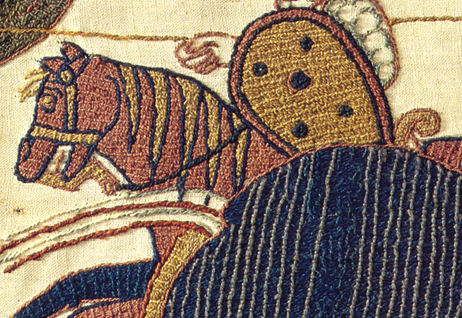
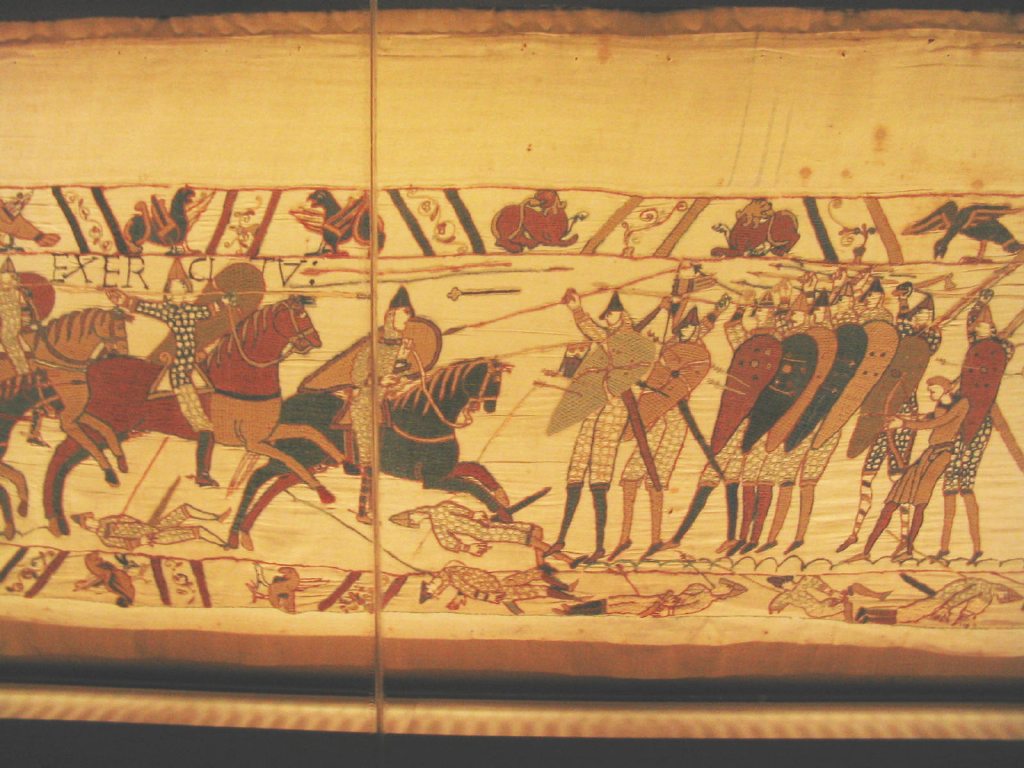
About a month ago, when I was researching sword fighting, I noticed something interesting while looking at photos of the Bayeux Tapestry. The charging Norman knights aren’t carrying lances in the traditional way we think of Medieval knights. No. Instead they were throwing them – more as if they were spears than lances.
This got me thinking about spears and lances and research I did centuries ago while I was still a graduate student doing a PhD in Medieval Studies. In my first or second year, I wrote a paper about spears and lances in Wolfram von Eschenbach’s
Parzival.
When Parzival gets to the Grail Castle, he witnesses a procession that culminates with his seeing the Grail. Most scholars, of course, focus on the Grail, which in
Parzival is quite different from the standard chalice that most people picture for the Grail. What I was interested in was the other items carried in the procession, in particular “der bloutec sper” – the bloody spear.
Notice, I said “spear”, not lance. This is a different weapon.
In fact, at least one Mittel Hoch Deutsch scholar – probably the great Joachim Bumke, but it’s been so long ago that I can’t remember for sure – pointed out that young Parzival’s sin wasn’t just killing his cousin, i.e., killing kin. But also that the weapon he used – his spear – was a common hunting weapon, not a knightly weapon, so it was a sin against knighthood as well.
OK, Parzival was written over the last decade of the twelth century and the first of the thirteenth. Something had definitely changed between the Bayeux Tapestry and the writing of Parzival.
I started to wonder how jousting evolved.
First, let’s get a little terminology straight.
- Spear – a long pole with a sharp point at the end, possibly even a separate point, such as a spearhead. Can be thrown or thrust.
- Javelin – smaller lighter version of the above. Usually meant to be thrown.
- Lance – a heavy, long pole meant to be held and thrust.
If we go back to Roman times, we find they used cavalry in their armies as support for the main unit of infantry. Until the latter part of empire, the period which would have been King Arthur’s, they were used for scouting and light skirmishing. In battle, two “wings” (alea) of cavalry were positioned one on each flank, to prevent the infantry from being outflanked. They relied on bows and arrows and spears that could be thrown.
The issue is one of equipment. Because of their lack of stirrups, Roman cavalry were not very effective when it came to directly engaging with the enemy through sword fighting or lance. Stirrups are an essential ingredient in keeping you in the saddle, as your feet in the stirrups provided leverage. Roman saddles had four horns to help stabilize a rider, but you could still be toppled off your horse.
 |
| Roman Saddle -- 4 horns but no stirrups |
Interestingly, the foe the classical Romans feared the most was the cataphract – the heavy horse cavalry that originated in Parthia (modern Iran). This force featured huge warhorses specially bred for the purpose (the first historical record of a breeding program). Both rider and horse were covered from head to foot with scale armor.
 |
| Cataphract. This one is from the 5th century -- roughly "King Arthur's" time. |
Cataphracts carried spears that were unusually long and heavy. These are still spears, not the heavy jousting lances we know from tournaments.
According to one source I researched, cataphracts used them to pierce their enemy. Without stirrups, though, a spear would have minimal impact. If you were galloping at full tilt at someone and ran him through, assuming you didn’t get knocked off your horse with the impact of the blow, you’d certainly get your spear tangled in the person you just ran through and have to, at best, abandon the weapon.
The power of a cataphract charge came from the mass of heavy horses themselves frontally assaulting a line, and supported by a barrage of arrows fired by archers stationed at the rear. The archers kept the enemy busy while the cataphracts charged.
Ironically, by the late Roman period, cataphracts have been absorbed into the Roman army and form the basis of its heavy cavalry. They’re also a key ingredient in Byzantine military strategy. And the source of the medieval knight and his equipment, as we know it.
(As another interesting aside, cataphracts were also a feature of Chinese armies during the San Guo – Three Kingdoms – period that followed the Han Dynasty.)
OK, fast forward to 1066 and the Bayeux Tapestry.
Stirrups appeared in northern Europe in the 9th century, so our Norman knights would have had them. But they haven’t changed their tactics yet from spear thrower to lance thruster.
By the mid twelfth century, things had changed. Tournaments as competitions to provide practice opportunities for knights had become so popular that Henry II of England forbade them. Interestingly, these tournaments usually began with melee, a mock battle. It featured a “lance charge”, in which the two sides charged each other and attempted to unhorse with their blunted lances as many of the opposition as possible. In other words, stirrups have changed the way knights fight.
As a result of Henry II’s forbidding tournaments in England, many English knights resorted to tourneying in France – including Henry’s own sons.
Success in a tournament didn’t just win a reputation; it also was worth a lot of money in prizes and ransoms. You could also win -- or lose -- your armor or your horse. This could be the making of a poor knight. (Yes, the movie "A Knight's Tale" does have some historical veracity.) In fact, it's how William Marshall, who started as the younger son of an insignificant lord, earn both wealth and the attention and trust of the Plantagenant kings.
While Henry may not have approved of the sport, his heir did. Richard I (the Lionhearted), when he ascended to the throne, granted licenses for five areas where tournaments could be held in England. The tournaments included jousting.
Early jousts appear to have started with the tilt – running at each other with lances – and then progressed on to battling it out with swords. The use of a piece of cloth down the middle to separate the combatants is a late development, arising out of the 15th century.
Jousting also resulted in some modifications to the chest piece (or cuirasse) of the set of armor. To help shield the chest from a powerful blow, armorers started shaping the piece so there was a hallow between the metal and the wearer's chest. Hence the reason why the armor worn during the Rennaissance and later has a pot-bellied look.
Jousting continued right on to the period of Henry VIII, who held some of England’s last tournaments. In fact, it’s postulated that a head injury sustained at a joust may have caused a personality change in Henry that turned him from a charming prince loved by all to a tyrant.